Salt Hermits
Hello, all – another week, another worldbulding update on the ocean world of Melusine. Today’s development update is about the earth elemental known colloquially as the Salt Hermits.
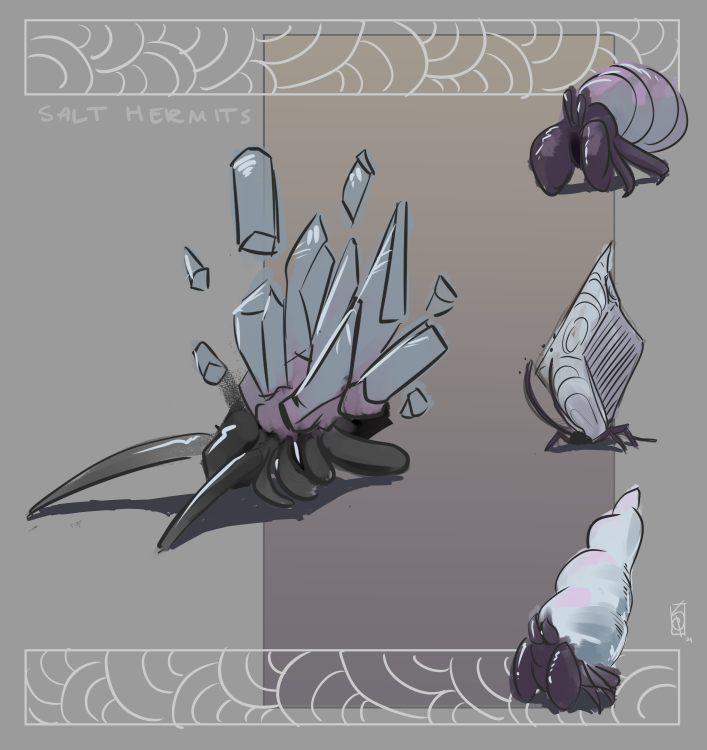
Their “shells” come in a variety of shapes, from the natural hermit-crab style to legitimate crystal growths.
So named for their strong resemblance to hermit crabs, the salt hermits are one of the most common earth elementals to inhabit the ocean floor and live aboard human ships. Unlike the ember pups, the earth elementals have been able to remain wild, but even in this state, they are benign and solemn towards humans and other lifeforms and are most helpful when left alone.
Like hermit crabs, they have crab-like legs, seemingly composed of volcanic glass, black like obsidian. As they grow in size, they need sand and fire to create a new layer to their shells. There are no discernible eyes or other sensory organs, and prominent terraturges propose that they sense the world around them seismically.
Unlike hermit crabs, they have no shells. Instead, these creatures possess a unique affinity for the mineral salt, and grow salt crystals from their backs. The shapes of these shells range from complex spiral constructions to the typical blocky crystals, depending on the age of the hermit.
Their ability to absorb salt makes them an indispensable part of shipboard life across all the waters of Melusine. They are one of the most reliable sources of renewable fresh water. Any well-equipped vessel on the seas, great or small, will have a small school of salt hermits living in the on-board water tanks.
When one grows too large, humans are able to shave the salt from the crystals, gathering it for food, sanitization, medicine, fire control, preservation, fertilizer, pest control, laundry, health, and plumbing. In return for this great boon, the salt hermit lives in relative comfort and safety for all of its days.
It is not known exactly how they reproduce, but it is suspected that they do so by fission. What is known is that salt hermits can grow to both tremendous age and size, functionally immortal if give enough material. The greatest example of this is known as the Salt Spire.
Seen from afar, the oldest and largest salt hermit on Melusine looks like a spire jutting up from the ocean floor. If one watches for long enough, they will see that the spire is not a static landmark, but moves, even slowly, the massive creature traversing the ocean. Thought to be a creature from before the fall of the firmament, the entire landmass is composed of immense, ancient salt crystals. It is a common nesting ground for sea birds and other winged things, and some brave humans have taken to building settlements in the sheer cliff-sides.
If this natural wonder wasn’t enough, the surrounding sea for hundreds of miles around the Spire is freshwater. This is not unheard of on Melusine, as great clusters of salt hermits can create patches of fresh water, but none of these are as large or as permanent as the shallows and wetlands around the Spire.
It is an entirely different biome to the surrounding ocean, marked by a ring of dark, freshwater algae. Creatures great and small exist in the underwater caverns and in the groves of aquatic trees. The Spire is an interesting world on its own, enough for another article, which will come on another week.
I hope you all enjoyed this peek into the world of Melusine. Until next week!

If you like my work, please consider supporting me! Thank you!