Welcome to WordPress. This is your first post. Edit or delete it, then start writing!
Blog
-
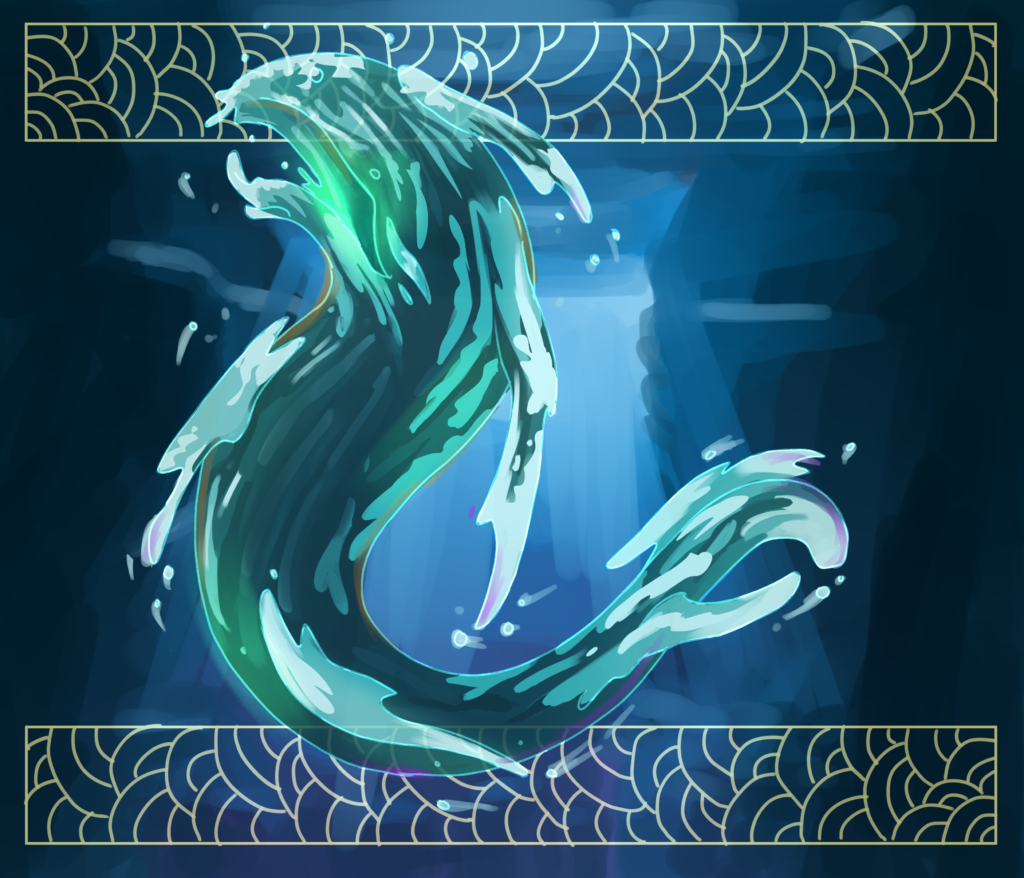
Brines, Water Elementals

The oceans of Melusine are full of monsters, creatures that lurk beneath the waves, and none are more numerous than the water elementals. The surface layers of the ocean are their territory and as a result, water elementals are exceptionally dangerous and powerful. They understand their place in the pecking order and only the strongest-willed elementalists can hope to command them.
Typically known as brines, these creatures are wild and tempestuous, known for frenzied fits of passion interspersed with periods of calm. They are usually quite large, although it is difficult to know the size (or, in truth, volume) of any given water elemental when they are usually partially, if not completely submerged. Their size and power often means they are more intelligent than the average elemental.
When an elementalist tames a Brine, they are considered “hooded”. They wear a personalized mask which identifies the brine and the elementalist they belong to. More on that later.

If you like my work, please consider supporting me! Thank you!
-
7/30/25
Studying Ghibli and trying to absorb it all into my stew 🍜

-
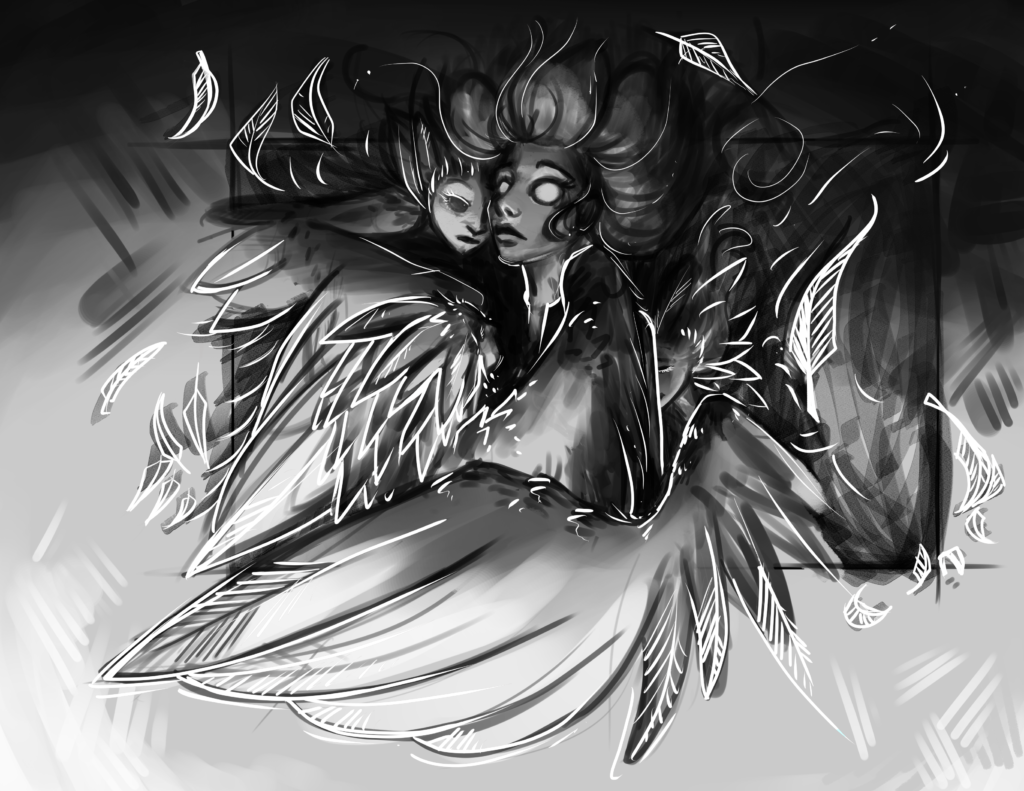
Chimes

Air elementals are powerful, near-invisible creatures that rule the air and skies. They have a particular fondness for playing with wind chimes, hence the name.
As the second most powerful group of elementals, Chimes rule the skies and generally cannot be tamed. Their power and tempestuousness is immense. They can, however, be consulted, cajoled, tempted, and appealed to. They are not treacherous. Instead, they are playful and childlike.
Naturally, they are extremely useful aboard sailing vessels, and the elementalists that can command them will never be short of work or coin.
They build ‘nests’ on cliffs, between rocks, on clouds, and in the highest points of the largest ships. These spaces are strange little eddies of wind, often containing stolen objects or filled with odd, disembodied sounds and voices.
Humans can also build nests for them out of large clay vessels called ‘whistling jars’. With a scattering of smooth holes across their surfaces, these whistling jars most closely resemble ocarinas, although much larger and not truly fit for playing music. However, the elementals make good use of them, playing through the holes and nesting in the hollow interiors.
It must be noted that most weather phenomena on Melusine is perfectly natural. Hurricanes, tempests, winds, gusts, and storms, are nothing more than mundane weather patterns, although they can be fearsome and destructive in their own right. Chimes, however, are capable of wreaking havoc. In terms of wild chimes, one alone usually isn’t something to worry about, but when they gather into groups, they tend to get particularly rowdy. As one might imagine, this can cause strong, violent winds. Older chimes, or extremely large groups of chimes present a particular danger, as there is a possibility they can brew up hurricanes and other weather disasters.
Another curious ability that these elementals possess is the ability to collect sounds. They are excellent mimics, often able to hear a voice or sound and reproduce it perfectly. The more intelligent an elemental, the more likely they are to use these collected sounds for rudimentary communication. Whether elementals of any sort are able to intelligently communicate at length is a matter of perpetual debate.
That said, the longer an elemental has a sound, the more degraded it becomes. Sounds will become eerie facsimiles of themselves and on windy nights, one might hear strange things out on the waves. However, sounds collected from supernatural beings, such as the gods, are as clear as the day they were collected.
Elementalists, priests, and people who study the elementals are often found following the flocks for the mere chance of hearing and recording words spoken in the voices of the gods themselves. This is can be a very profitable, but dangerous, endeavor. There have been tragic reports of truly ancient voices causing strange visions, madness, death; often, all three, and not always in that order. There are some things that are better left unearthed, but fortunately, there are few air elementals old enough to have such dangerous stolen voices.
And that is all for this week. Please enjoy the illustration, and I plan to be back next week with more about the brines!

If you like my work, please consider supporting me! Thank you!
-
Salt Hermits
Hello, all – another week, another worldbulding update on the ocean world of Melusine. Today’s development update is about the earth elemental known colloquially as the Salt Hermits.

Their “shells” come in a variety of shapes, from the natural hermit-crab style to legitimate crystal growths. So named for their strong resemblance to hermit crabs, the salt hermits are one of the most common earth elementals to inhabit the ocean floor and live aboard human ships. Unlike the ember pups, the earth elementals have been able to remain wild, but even in this state, they are benign and solemn towards humans and other lifeforms and are most helpful when left alone.
Like hermit crabs, they have crab-like legs, seemingly composed of volcanic glass, black like obsidian. As they grow in size, they need sand and fire to create a new layer to their shells. There are no discernible eyes or other sensory organs, and prominent terraturges propose that they sense the world around them seismically.
Unlike hermit crabs, they have no shells. Instead, these creatures possess a unique affinity for the mineral salt, and grow salt crystals from their backs. The shapes of these shells range from complex spiral constructions to the typical blocky crystals, depending on the age of the hermit.
Their ability to absorb salt makes them an indispensable part of shipboard life across all the waters of Melusine. They are one of the most reliable sources of renewable fresh water. Any well-equipped vessel on the seas, great or small, will have a small school of salt hermits living in the on-board water tanks.
When one grows too large, humans are able to shave the salt from the crystals, gathering it for food, sanitization, medicine, fire control, preservation, fertilizer, pest control, laundry, health, and plumbing. In return for this great boon, the salt hermit lives in relative comfort and safety for all of its days.
It is not known exactly how they reproduce, but it is suspected that they do so by fission. What is known is that salt hermits can grow to both tremendous age and size, functionally immortal if give enough material. The greatest example of this is known as the Salt Spire.
Seen from afar, the oldest and largest salt hermit on Melusine looks like a spire jutting up from the ocean floor. If one watches for long enough, they will see that the spire is not a static landmark, but moves, even slowly, the massive creature traversing the ocean. Thought to be a creature from before the fall of the firmament, the entire landmass is composed of immense, ancient salt crystals. It is a common nesting ground for sea birds and other winged things, and some brave humans have taken to building settlements in the sheer cliff-sides.
If this natural wonder wasn’t enough, the surrounding sea for hundreds of miles around the Spire is freshwater. This is not unheard of on Melusine, as great clusters of salt hermits can create patches of fresh water, but none of these are as large or as permanent as the shallows and wetlands around the Spire.
It is an entirely different biome to the surrounding ocean, marked by a ring of dark, freshwater algae. Creatures great and small exist in the underwater caverns and in the groves of aquatic trees. The Spire is an interesting world on its own, enough for another article, which will come on another week.
I hope you all enjoyed this peek into the world of Melusine. Until next week!

If you like my work, please consider supporting me! Thank you!
-
Ember Pups

Metal bodies to house the delicate cores of the ember pups 
Cooking implements and lanterns This week, I have a lore drop concerning the elementals of the world of Not One Scale to Waste. Soon, this will be contained in an interesting ‘field notes’ style aesthetic, but for now, I’ve been excited to start sharing the lore concerning the fire elementals in water-logged world of Melusine.
Before the fall of the firmament, the four varieties of elemental creatures on Melusine were wild and powerful. They were only able to be tamed and trained by elementalists with strong wills and hardy constitutions.
After this great cataclysm, the face of the world was fundamentally changed, permanently flooded from horizon to horizon, with only the tiniest landmasses rising above the waves. Dangers untold lurk blow, from ancient technology to sea monsters, to the ghosts of the lost and the damned. Humans changed to suit their new world, but they were were still forced to take refuge on ships, and the threat of feral fire was not welcome aboard these vessels. To avoid extinction, it is said that the fire elementals, possessing some level of sapience, tempered themselves.
Now, an untold time later, these once fearsome creatures have made themselves docile, attractive, and practically harmless. It doesn’t take much to command them, and they rarely, if ever act out. If one has an affinity to fire elementals, it is not something one can brag about.
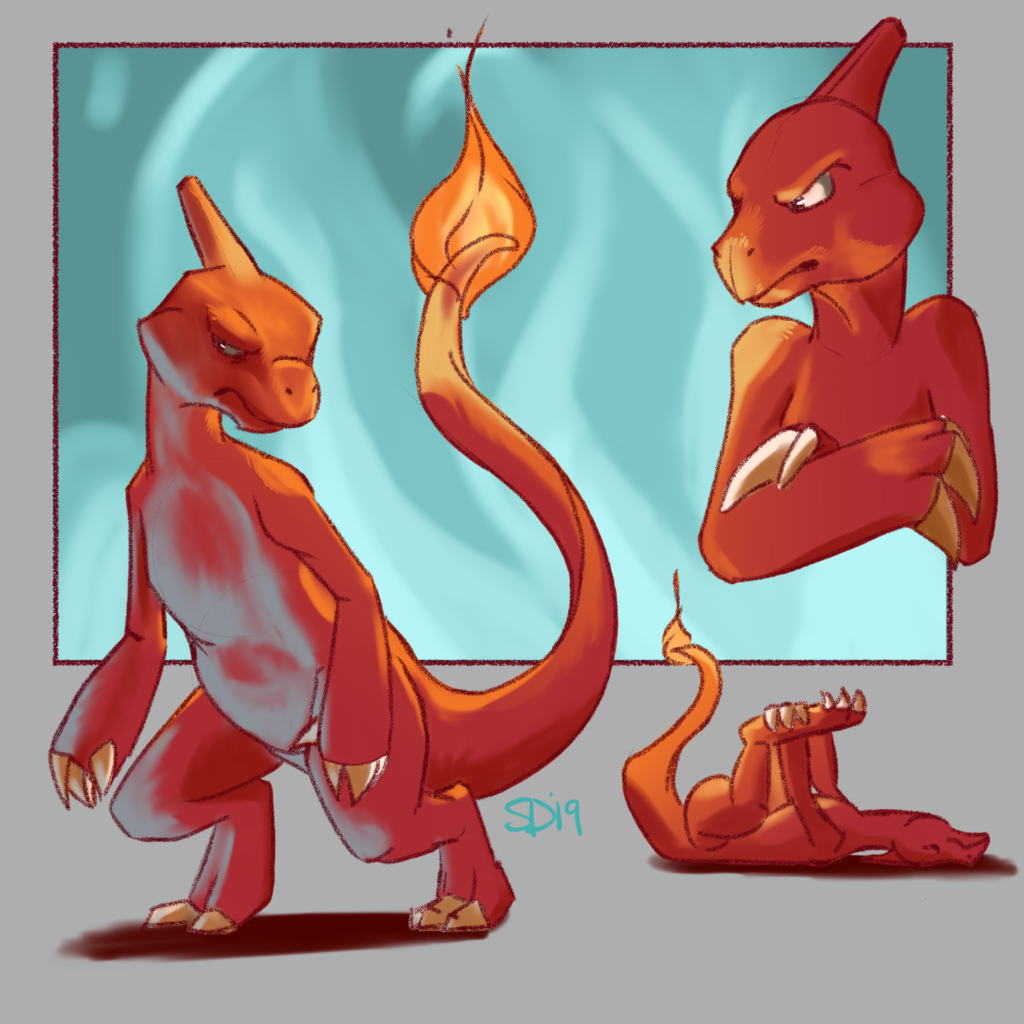
The most common variety of fire elemental is affectionately called the “ember pup”. These friendly creatures are found on ships the world over, seated under cooking fires and gathered up in braziers.
Their cores look like smooth coal-black stones wreathed in a warm flame, and they are happiest when gathered together into a pile. Humans have taken to creating bodies for them out of various materials, from metal to fired clay, and by some magic, they are able to animate these vessels and wander their home ships, shedding light and warmth, or following their favorite humans. They can take on the forms of cats, dogs, birds, and sometimes larger creatures, like the rare cow or pig.
They are quite loyal, and naturally cautious of water and water elementals, but something of their ancient nature remains—they tend to burn the brightest in adversity and adventure. Many a human has claimed that their ember pup saw them through a truly deadly storm.
I’ve provided a few sketches that I’ve done of these throughout the years while developing Melusine and Not One Scale to Waste. The ember pups are a favorite of mine, featuring in a lot of the stories I’ve written—understandably, since they are a fundamental part of shipboard life—and I’m excited to show more, along with other varieties of elementals.
Until next week!

If you like my work, please consider supporting me! Thank you!
-
The World Of Melusine
On an endless sea, mankind lives aboard vessels wrought of leviathan bone and hide. They worship the stars and the barbaric deities of the sea. They build their cities atop the immense bones of slain monsters, or within the shelter of a leviathan’s cavernous carcass, where the remains of strange spirits can whisper long lost songs into their dreams.Elementals of the air and the water are dangerous and capricious and harnessing them is an invaluable profession. Elementals of earth and fire seem to be man’s only friend in nature, if only because they long ago yielded to the dominion of the other two.
Beneath the surface, the remains of ancient civilizations still ghoulishly twitch. Scavengers, scholars, and seers all find their livelyhood in these ruins, but one wrong move can unleash strange, often incomprehensible dangers.
God-like leviathans inhabit the deeps and, some say, the spaces between the stars. They spawn cults, and rituals. They ask for bloody sacrifices. Religions rise and fall with the ages. Still, there are tales of beings from the ancient world who can still teach a man the old ways.
Life is hard on the waves, harder still knowing that the ancient stories say it was not always so. Once, the lands were whole and the seas were teeming and warm. A man could speak with his gods face-to-face.
Then, one day, men and their ancient gods delved too deep, sought forbidden knowledge and unleashed something terrible. The lands broke, the world flooded. Man’s intellect dimmed and his body changed, taking on monstrous shapes and appetites. His gods went mad. Now, all is obscured and paradise is no more.
-
March 2025 Promptathon – War Rabbits, Part 2
I stuck with War Rabbits, which means I only lightly followed the prompts. I had a great time, though. I especially like the iguanadragon, because of course!

Like Clowns In A Bank 
As Seen Through Fresh Eyes 
Scrapyard Steed 
Reversal of Fear 
Dead or Alive 
King of Spring 
Between Two Slices -
Dec 2024 Promptathon – War Rabbits
This season’s promptathon accidentally ended up with a unified theme that I absolutely fell in love with: rabbits. And then… birds. And a fox and some bears. It always comes back to silly animals.
Regardless, worldbuilding this way made it so much easier to tackle each prompt and I actually found myself looking forward for the next unreleased prompt. I’m very happy with how these turned out!

Delicious Technology 
Mundane Services for a Fantasy World 
A Matter of Interpretation 
Everyday Helper 
Feasts are for Everyone 
Just A Little Guy 
Brand Wars -
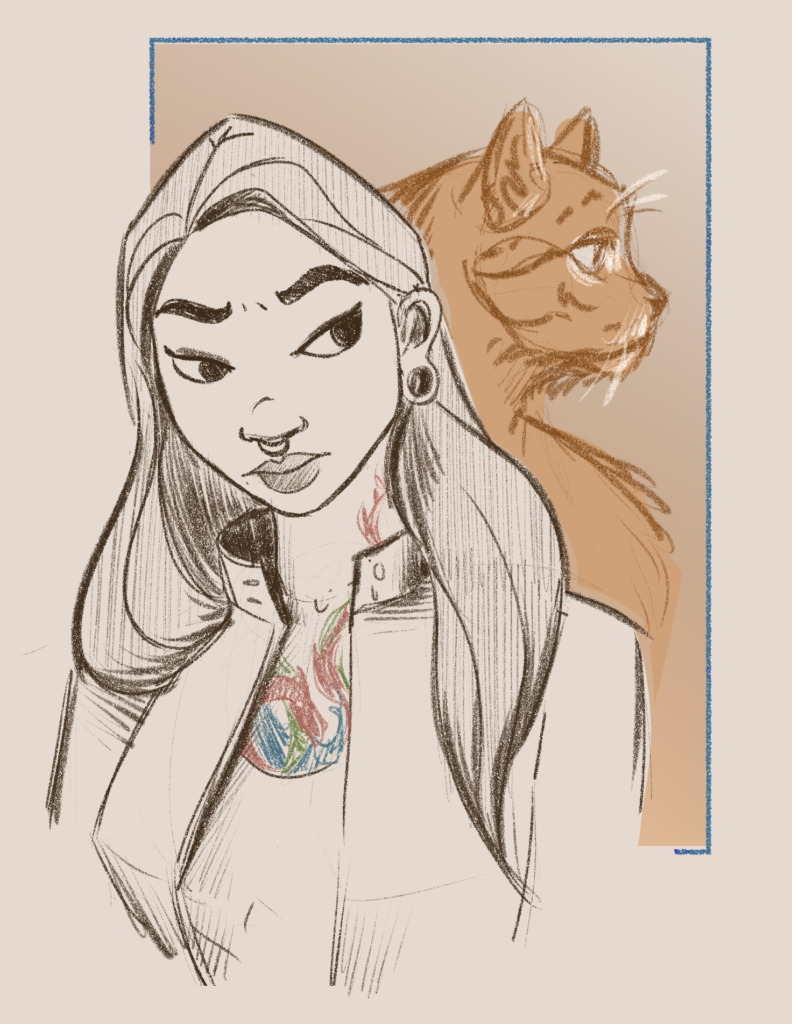
Character Design: Nari
This is my final project for my Character Design class with CGMA. It was my first time taking a class with CGMA and it was so worth it. I really loved the opportunity to be in a classroom setting again, even online.
Thanks to Drawabox, I felt really comfortable with pushing myself—maybe too comfortable? I got a big head sometimes and waited until the last minute to finish my assignment. There are parts even here where I feel are rushed. I know, I know- you’re not supposed to point out your mistakes, but waiting until the last minute is a bad habit I’d like to tackle before I take more online courses.
I’ll post my other CGMA work separately but these sketches are the culmination of a lot of great exercises. I learned how to work on facial expressions and for Nari by studying the concept work from Disney’s animated Mulan (my favorite movie growing up). I needed to figure out how to draw those Asian facial features and expressions because otherwise I have same face syndrome!

Posing is where I really felt how much Drawabox helped my ability to see form. This was as simple as finding references and drawing Nari in those poses.

As for Nari herself, I envisioned her to be sleek, agile, and cool. So I focused on flowing lines, big movements, and a street wear wardrobe, which was particularly fun to study and draw.
For her final pose, I landed on using Daniel’s famous pose from Karate Kid, to give her that dynamic, dangerous look. The red palette is my favorite, but I like the jacket patterns on purple and yellow more.

There’s more to Nari—she’s actually part-dragon, with a bunch of fun magical powers, but that went beyond the scope of the project. I look forward to tackling that later.